

notes and studies
-

Tajiki identity caught between Iran, Islam, and Russia
The Republic of Tajikistan came into being in late 1991 as a state with no historical precedent. Emerging from decades of secular Soviet political and cultural control, cut off from the Tajik heartland of Bukhōrō and Samarqand, and facing a potent challenge from a charismatic Islamist movement, the country faces a great need to construct a cohesive and durable national identity. Several options were and are available to the leaders of the country: an embrace of Iranian ethnic roots, a return to the Islamic tradition that had defined the region in in the pre-Soviet era, or a continuation of the pattern of Soviet society and civil religion. While any one may appear a logical choice, each path brings with it certain hazards. This article discusses these various identities available to the Tajik leadership and how the country has navigated a careful balance between them.
-
Early Islamic history and memory in radical Islamist discourse
Radical Islamists hearken often to events, figures, and symbols from early Islamic history in their recruitment and mobilisation efforts. This short study examines the radical rhetoric regarding the Battle of al-Qādisiyyah and the imagined heroïne and rôle model al-Khansāʾ as examples of how radicals reinterpret history to further contemporary interests.
-
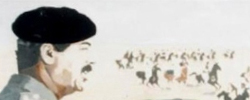
A Brief analysis of ‘Ṣaddām’s Qādisiyyah’
The choice by Ṣaddām Ḥusayn (Saddam Hussein) to call his eight-year war with Iran ‘Ṣaddām’s Qādisiyyah’ was a deliberate effort to hearken back to the Seventh-Century Battle of al-Qādisiyyah during the Arab-Muslim conquest of Iran. This short study examines Ṣaddām’s manipulation of the memory of al-Qādisiyyah and how this discourse reflected an ‘Arab-Islamist’ idiom that allowed him and his régime to fuse religious and nationalist sentiment into one ideological discourse.
-

Rasmī or aslī?: Arabic and its impact on modern Israeli Hebrew
The revival of Hebrew in recent times provides an interest case study of one language’s influence upon another. There are many similarities between Israeli Hebrew, on the one hand, and Modern Standard Arabic and Levantine Arabic, on the other. What are these similarities and what conclusions can we draw from them about the extent and manner of Arabic’s impact on Hebrew?
-
Primary sources on the Bajīlah’s ‘fourth’
During the Arab-Muslim conquest, numerous tribesman from Arabia settled the fertile land of central Iraq. A collection of reports regarding the specific case of the tribe of Bajīlah provide an opportunity for studying the narrative development of Islamic historiographical literature. This article presents primary source literature relating to the Bajīlah’s land claims.
-
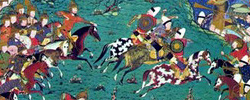
Qādisiyyah in modern Middle Eastern discourse
The Battle of al-Qādisiyyah during the Arab-Muslim conquest of Iran in the 630s has since taken on a reputation of legendary proportions and its image today highlights the function of history and memory in the modern Middle East. From Ṣaddām Ḥusayn (Saddam Hussein) to al-Qāʿidah, Qādisiyyah is exploited for political uses, and the frequency of its nomenclature throughout the Muslim world exemplifies its continuing emotive power.
baha’i studies
-
![The Shrine of the Bāb in Haifa, Israel. [Source: D Gershon Lewental (DGLnotes)]](http://bahai.dglnotes.com/media/ShrineofBab.jpg)
The Shrine of the Bāb in Haifa, Israel. [Source: D Gershon Lewental (DGLnotes)] The Bahāʾī faith emerged in Iran during the mid-Nineteenth Century as a new religion within the Abrahamic monotheistic faith tradition, focusing on human unity and equality. Although the faith and its prophet-founder, Bahāʾ-Ollāh (also Baháʾuʾlláh, born Mīrzā Ḥusayn-ʿAlī Nūrī, 1817–1892) came from Iran, persecution brought them to ʿAkko (Acre) and Haifa in Ottoman Palestine, where the leadership of the faith has remained ever since. For nearly a century, the families and descendants of Bahāʾ-Ollāh and many of his early followers continued to live and thrive in the land, as it passed from the Ottomans to the British to the Israelis. I have conducted extensive research on the relations between the Bahāʾī community and British, Jewish, and Israeli authorities at the Israel State Archives and offer here general information on the Bahāʾī faith, original studies, and primary sources and other resource materials .